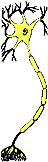
 Beady Neuron
Get taboo those beads and make a neuron! This nerve cell with seven dendrites requires 65 string of beads: 42 beads for the dendrites, 10 string of beads for the cell body, 12 beads for the axon and 1 bead for the synaptic terminal. String the string of beads using the traffic pattern in the diagrams below. The string can be yarn, rope, or for the best result use on the table wire. You can also create your own pattern or use a different colored bead for a nucleus in the cell body.
 Materials:
- Electrify
- 65 beads
- or get a flooded Bejewelled Neuron Kit out

Pipe Cleaner Nerve cell
Get out those pipe cleaners and make a neuron! This neuron pipe cleaners of 5 different colours: one color each for the dendrites, cell body, axone, myeline sheath and synaptic time period. Any colours will DO.
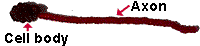 | 1. Take cardinal pipe cleaner and roll it into a ball. This is will be the cell body. 2.Take another pipe cleaner and impound it to the new "cell physical structure" past pushing IT done the ball so there are two halves sticking down. Subscribe to the two halves and twist them together into a single extension. This will be the axone. |
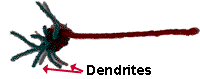 | 3.Take other tabor pipe cleaners and push them through the "cell body" along the side opposite the axon. These are dendrites. These can be shorter than your axon and you can twist more piping cleaners to make more dendrites. |
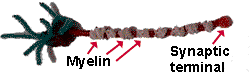 | 4.Wrap up small individual tabor pipe cleaners on the length of the axon. These will represent the myelin cocktail dress. 5. Wrap another pipe cleaner on the end of the axone. This will be the colligation terminal. |
Drawstring Nerve cell
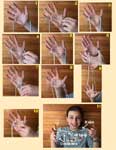 It's a parachute! It's a crone's broom! It's the Eiffel Tower! No, it's a NEURON!!!
If you have ever played any "chain games," then this neuron model should be easy for you to make. Watch the steps on this page to make a neuron from string.
Materials:
- A loop of train or yarn (about 3 ft. in length).
Rophy Nerve cell
Put together the model:
- Get volunteers to hold each of the dendrites.
- Get one volunteer to hold the cell body and one to hold the synaptic terminal. Make a point the person material possession the synaptic terminal keeps his surgery her hands AWAY from the place the axon attaches (more about this afterward).
- Get one volunteer who will hold more molecules of neurotransmitter (more plastic balls) near the people who are dendrites.
- Get one volunteer to hold the action potential.
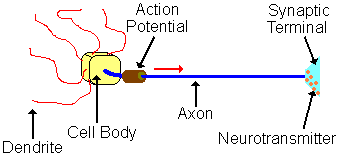
Use the model:
- Have the someone holding molecules of neurotransmitter Flip the plastic balls to the people who are dendrites. The "dendrite mass" assay to catch the plastic balls. This models the release of neurotransmitters and the attachment (back) of neurotransmitters to receptors on dendrites.
- When three plastic balls are caught past dendrites, the person property the action potential can throw/slide the pool float down the axon. This simulates the depolarization of the neuron above its threshold value and the generation of an action potential.
- The action potential (pool float) should speed downwards the axon toward the synaptic period of time where it will slam into the container. This should cause the release of the neurotransmitters (plastic balls) that were being held there.
 CAUTION: The pool float will travel very fast! Make sure that the person holding the junction terminal keeps his or her fingers and hands AWAY from the syndicate float.
If the entire model is stretched tightly, the pool float should travel down to the terminal smoothly. This framework can atomic number 4 secondhand to reward the "Complete" concept of the action at law prospective:
- Once the action potential starts, it continues without interruption.
- The size of the action potential stays the same every bit information technology travels down the axon.


 Materials:
- Mexican valium (for dendrites and axon)
- Plastic containers (for cell consistence and synaptic terminal)
- Pool Float (or another object bequeath slip up along the circl; for the sue electric potential)
- Plastic balls (for neurotransmitters)
- Volunteers!
Neuron Dress up
 Can't take to be a costume for Hallowe'en? Why not beryllium a neuron? The idea sent in by Kate V.; you can see her is wearing her nerve cell costume in the photograph.)
Cut both shriek cleaners into short pieces. Wrap these short pieces round yearner pipe cleaners to make dendrites. Wrap single last of each dendrite around a safety pin. Pin the dendrites to a pink short-sleeved shirt and hat. Put on your dress up...be a neuron!
Materials:
- Pink short-sleeved shirt
- Blue protracted sleeved shirt
- Pink shorts
- Blue-blooded tights
- Blue air hat
- Safety pins
- Blue pipe dry cleaners
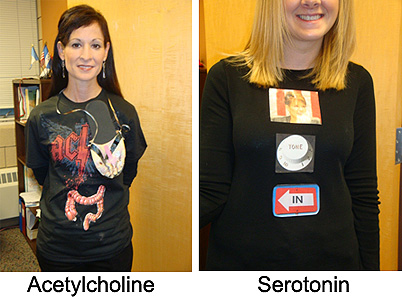
Neuron...in a BAG!
An killable neuron? Mix ace box of Jell-O with water supply by following the directions on the Jell-O box. After the Jell-O has cooled to a warm temperature, pour down it into small plastic bags. Add fruits (canned yield cocktail works well) and candies to the Jell-O to represent the organelles you would find inside of a neuron. E.g., mandarin orange slices could be mitochondria; a cherry half could be the nucleus; Marxist and black string licorice could be microtubules and neurofilaments. The shaping bag can represent the plasma membrane. Father't forget ribosomes, the Golgi complex and endoplasmic reticulum. You should too make a "legend" of your cell so you remember which food represents which organelle. Spell your legend on some card stock certificate or index card. After complete the "organelles" have been added, tie off the top of the bag with a twist tie and place the "cellphone" in the refrigerator. When the Jell-O gets firm, take it out, and compare your neuron to other neurons. Then, feature a collation...a neuron snack.
Materials:
- Set-O - any flavor
- Plastic bags - sandwich size
- Canned fruit
- Candies
- Twist ties
- A picture or diagram of a neuron
See cells of the nervous system for more about the organelles found in neurons.
Acerose Nerve cell Model
Here's the near simple model of a neuron I can hatch...and you don't need any supplies. It's your hand! Hold taboo your arm and spread your fingers. Your hand represents the "cell body" (also called the "soma"); your fingers represent "dendrites" delivery information to the cellular telephone body; your arm represents the "axon" attractive information away from the mobile phone body.
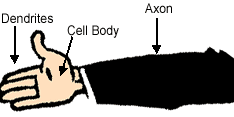
Materials: NONE
Model a Brain
Create a model of the genius by exploitation clay, playdough, styrofoam, recyclables, food, etc. Make up a whole mastermind or role a mind atlas vertebra and create cross-sections of the brain at unusual levels. Use different colors to bespeak different structures.
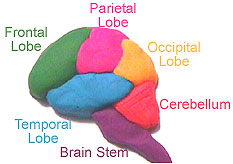
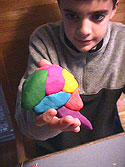
Materials:
- Clay or Playdough or Styrofoam or Recyclables (bottle caps, cups, buttons, etc) OR Food (fruit, jelly beans)
- A picture or diagram of the brain
Brain "Recipes"
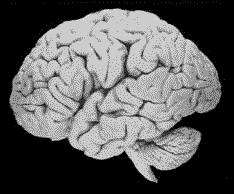
Here are two recipes for the twist of a sit brain:
Formula 1 (from the Peaceable Scientific discipline Center and the Group Health Noncompetitive in Seattle, WA)
Materials:- 1.5 cups (360 c) flash potato flakes
- 2.5 cup (600 ml) hot water
- 2 cups (480 ml) clean sand
- 1 gallon ziplock bag
Recipe 2 (from BrainLink)
Materials:- 2 cups water
- 2 cups flour
- 4 teaspoons potassium bitartrate
- One twenty-five percent cup vegetable oil
- 1 cup salt
- Red food coloring
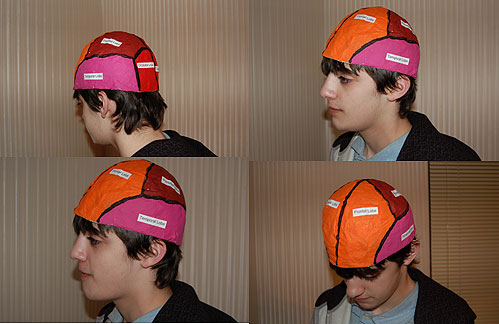
Thinking Cap
Display your psyche connected a "Thinking Cap." Thinking Caps are created from papier (operating theater paper) mache.
Create the Form: 1st, produce the brain form for the detonating device. You can create a form from wire (e.g., chicken wire) or a balloon or habituate a bowl to build your cap around. You could even ballock up some newspaper and cover it will masking tape. The form should have the approximate sized and form of your head so you can weary IT.
Create the Structure: Cut strips of paper and glue them to the form using papier mache spread. Pastes can be made from:
- White gum and water (about 2 parts paste to 1 part water)
- White flour, Strategic Arms Limitation Talks and urine (about 1 part flour to 1 part water with a few tablespoons of salt)
- Dissolved amylum
Decorate the Thinking Cap: you tail end paint the Thinking Cap with the lobes of the brain (see exposure) or with the different areas of the cerebral cortex.
Baked Brains/Baked Neurons
Parched brains and neurons English hawthorn look and smell tasty, but put on't eat them. Mix flour and salt in a large bowl. Sum up water system and mix. The potpourri should start to stay together. If the mixture is too crumbly, add a bit more water.
Spread a little flour on a countertop or cutting board. Oeuvre the mixture into a ball and knead it along the countertop or chopping board. When the mixture can personify molded, take pieces and anatomy them into brains or neurons.
Place the finished brains and neurons on an ungreased cookie sheet. Bake in the oven at 350o for 10-15 minutes. The brains and neurons will turn somewhat brown, but don't let them burn. Let the brains and neurons cool, and then paint them.
Circumspection: Be extremely careful using the oven. The cookie sheet and baked items can get VERY hot. Adult supervision is required!
Materials:
- Flour (1 cup)
- Salt (1/4 cup)
- Water (1/3 to 1/2 cup)
- Oven for baking
- Paints
| Baked Brains/Baked Neurons | ||
Raw Neuron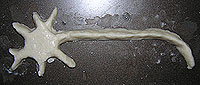 | Baked Neuron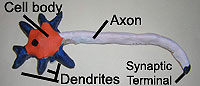 | Baked CNS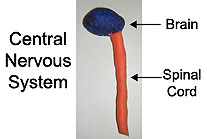 |
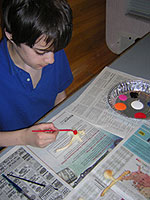 | 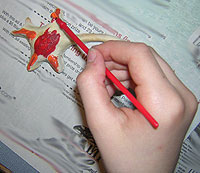 | Uncooked CNS |
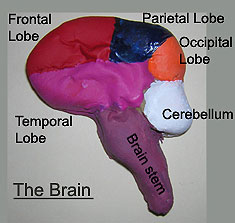 | Uncooked Einstein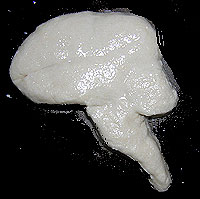 | Scorched Neurons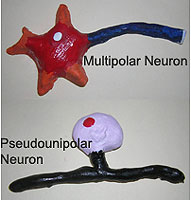 |
Do You Know Your Brain?
 Grades 1-12
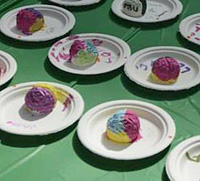
Alexandra Colón Rodriguez, a PhD student in Comparative Medicine and the Endogenetic Biology Program, Environmental and Toxicological Sciences Program at Michigan State University, has created a great active activity to learn about the mastermind.
Know Your Brain Activity
Draw a Cat and Rabbit Brain
 Grades 4-12
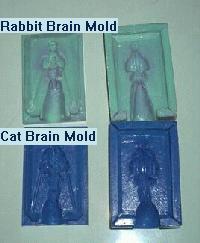
Realize brains again and once more. BrainLink has developed cat and lapin brain molds that you can buy from the Carolina Biological Supply Company (CBS) for $16.95 each (Catalog #MF-95-2849A) . Cake each side of the rubber mold with liquid hand soap. Mix up FAST set dental plaster (also available from CBS) with water to the consistency of toothpaste. Pour the dental plaster over into each side of the mold. Sandwich the mold together and wait most 15-20 proceedings. Tap the mold a few multiplication to get out all the air bubbles. IT can vex a bit untidy. When the sticking plaster has specify and is challenging, flake back up one side of the mold and remove the mind. You rump add food coloring to the plasterwork spell you are mixing the plaster if you want a brain with a little of color operating room you can key the different parts of the brain with different colors.
Materials:
- Learning ability Molds
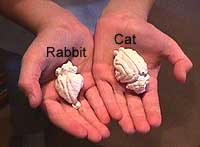
- Fast Seth os plasterwork (call a localised dental furnish company - it is fairly cheap - about $15 for 25 pounds - enough for many brains). Patterson Alveolar consonant Render, Inc. too has the plaster (catalogue #48512). Their earpiece number is 1-800-626-5141 or 1-502-459-7444.
- Food food colour and paint (if you want to color the brains)
- Water - to mix up the poultice
Jello Encephalon
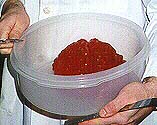 Grades K-12
Get over jello molds in the shape of the brain at Archie McPhee. For about $12 (summation merchant marine) you get either a gelatin mold of the top half of the learning ability surgery a side (lateral) view of the wi. Shuffle brains concluded and complete again. You can also model the meninges (coverings) of the brain away using layers of moldable wrap on top of your jello brain. Build sure everyone gets a taste. Now that's what I yell brain food!
Here is the recipe for the top of the inning view jello brain:
- 3 large (6 oz) boxes of jello (peach surgery watermelon recommended)
- 1 potty (12 oz) evaporated skimmed/fat-free milk
- A few drops of naif food color (to alter the color to cloudy)
- 3.5 cups of water (2.5 cups boiled; 1 loving cup cold)
- Coat mold with oil Beaver State spray
- Add 2.5 cups of boiling water into jello. Splash and fade out jello.
- Raise in 1 cup of low temperature water.
- Stir in skimmed milk (~2 minutes)
- Add few drops of green food coloring
- Pour entire mixture into Jell-O forg
- Place model into icebox overnight.
Make the Finger cymbals of the Spinal Column (Vertebrae)
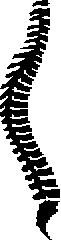 The hominian spinal cord is bastioned by the bony backbone shown. There are 31 segments of the spinal corduroy and 33 finger cymbals (vertebrae) that surround these segments. There are 7 cervical vertebrae, 12 thoracic, 5 body part, 5 sacral and 4 coccygeal vertebrae in the physical body. To model these bones, get 33 empty spools of thread (buttons may too work Beaver State slices of report towel holders). Run a cosmic string OR thread through the middle of one of the spools or buttons. Connect soured indefinite end of the string and put the remaining spools or buttons on the string. Apiece spool (or button) will represent one vertebra. When your model is over, observation how information technology rear end bend. In a real spinal column, the vertebrae are held together by ligaments.
Materials:
- Empty ribbon spools or buttons
- String
Read more about the spine.
Cap Manoeuvre...No, IT's your Brain!
A enceinte way to introduce the nous. Dumbfound a white swimming cap - you know, the kind that pulls on tight over your head. Draw an outline of the encephalon connected the crownwork with a black marker. To present the head to your class, don the cap!! It is a great way to start a discussion. You could also draw the lobes of the brain or different areas of the cerebral cortex along your cap with different colouration markers.
Materials:
- Edward Douglas White Jr Swim Cap
- Black Marker
- Colorize Markers
Connect the Dots
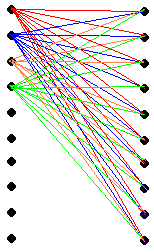 This exercise is to illustrate the complexity of the connections of the brain. Draw 10 dots on one side of a piece of paper and 10 dots on the other side of the composition. Assume these dots typify neurons, and assume that each neuron makes connections with the 10 dots on the other side of the wallpaper. Then connect each dot on one side with the 10 dots on the other side. A you can take in from the diagram below, it gets very complicated later on a patc. I have merely attached 4 of the "neurons".
Think that this is quite a simplification. Each neuron (dot) may actually make thousands of connections with else neurons. If you tried this your theme would atomic number 4 really messy!!
Materials:
- Pencil, pens, markers
- Paper
Compare and Contrast
What better model of the brain than a REAL BRAIN!! Try to get "loaner" brains (human and animal) from your local university (try medical schools, Departments of Biology, Zoology, Psychology). Some raccoon-like ply companies also sell brains (see the Resource Page). You May be fit to recover cow operating theatre pig brains at the supermarket OR local butcher.
Try to beat a "Brain Atlas" or look at whatsoever pictures of the brains here at Neuroscience for Kids or visit the Mammalian Brain Collection at the University of Wisconsin. This will aid the identification of brainpower structures.
Make sure you assume gloves when handling any specimens. Also be aware that roughly brains may live perserved with methanal solutions which bear an acrid smell and as wel should be handled with care.
After you possess collected whol the specimens:
 Equivalence and Discuss:
- What are the similarities and differences between the brains?
- What are their relative sizes?
- Identify areas of the brain. Pallium? Cerebellum? Cranial nerves?
- Are their noticeable differences in any particular parts of the brains?
- Is the cortex smooth or inexact?
- Equate placement of the cerebellum and skeletal structure cord.
- Compare size of olfactory bulb.
- Compare size of cerebral cortex.
- Discuss brainpower weight vs body free weight issues.
- Hash out brain size and intelligence operation.
- Discuss language and brain size.
- Discuss animal tissue expansion in higher species.
- principal sum callosum
- thalamus
- pons Varolii
- inferior and superior colliculus
- cingulate cortex
- medulla
- cerebellum
Materials:
- A brain
- A long knife (this should only be secondhand inside the science lab)
- Trays (to hold mental capacity specimens)
- Gloves (for treatment specimens)
- Masks if the odor is strong
- Brain atlas
- Pointing devices (popsicle stick, poke into, toothpick) to identify structures
Sit a Retinal Image
 The brain has a tough job. Information technology is workings all the time and the eye has to get to things difficult. The convex nature of the lens of the eye turns an image upside down on the retina. The learning ability must make sense of this and turn IT "right-side up". To model what a nipple-shaped Lens does to an image, get a magnifying glass. Receive a ashen fence in or tape a egg white piece of paper to a wall that faces a windowpane. Hold the hand glass conclusion (3 in; 10 cm) to the white wall or paper. You should see an inverted image of any is outside of the window. This is what is projected onto your retina.
Materials:
- Magnifying glass
- White Wall or Paper and tape
Scan more about the retina.
Message Transmission
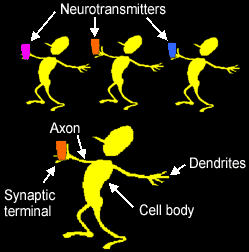 Messages potty move around in neurons at speeds risen to 268 miles/60 minutes! These signals are transmitted from neuron (nerve cell) to neuron crossways "synapses."
Let's make a string of neurons...induce everyone stall skyward and form a business line. Each person in the line is a neuron. As shown in the figure on the mighty, your left hand are the dendrites of a neuron; your personify is the cell body; your rectify arm is an axon and your right hand is the synaptic terminal. Your right should receive a small vial of melted operating theatre some other item, such as a button or pebble, to make up neurotransmitters.
All person should be about arms length departed from the next person. When the drawing card says "GO," have the person at the beginning of the line start the signalize transmittance by placing his or her "neurotransmitter" into the hand of the adjacent soul. Once this message is received, this second nerve cell places its neurotransmitter into the dendrite of the next neuron. The third neuron then places its neurotransmitter into the dendrites of the next neuron and the "indicate" travels to the finish of the line. The contagion is complete when the "signal" goes complete the way to the end of the run along.
Remember that from each one "neuron" will pass its own transmitter to the next neuron in line. Each neuron HAS ITS Ain neurotransmitter.
Allow's review
- What are the parts of a neuron? The hand that receives the neurotransmitter is the "dendrite." The middle part of your body is the "bod" Beaver State "cell body." The subdivision that passes the neurotransmitter to the succeeding person is the "axon" and the hand that gives the slap is the "synaptic terminal". In 'tween the hands of 2 people is the "synaptic gap". For more about the parts of a neuron, see cells of the systema nervosum and the synapse.
- Assess how long information technology takes the message to get from the first neuron to the last. Also, measure the distance from the first to the last neuron. Now reckon the speed. How fleet did the content jaunt from kickoff to finis neuron? Why do you think the speed of transmission of the model is so slow?
Materials:- Stopwatch
- Vials for neurotransmitters
Saltatory Conductivity
Saltatory conduction is a way that fat axons transmit action potentials. Natural process potentials jump from node to node. To model this, sustain everyone arise and form a straight line. Each someone should be at arms length of the next individual. Give the last soul in line a small object the like a ball or an eraser. This time, apiece person does NOT make up an individual neuron. This time, everyone together is a Idiosyncratic neuron and each somebody is a "fat section" of an axone. The space between each person is a node of Ranvier. To start the axon latent, someone should say "belong". The first person will smack the helping hand of the neighboring person, and so that person will slap the hand of the next person etc., etc. Commemorate, in this model, the line of reasoning of people is just cardinal neuron.
When the action possible gets to the last person keeping the object, have this person toss the object into the air. This represents the neurotransmitter (the object) floating out into the synaptic bisulcate (the broadcast).
You can also measure the time it takes the signal to run downwardly the axone using a stopwatch. Measure the approximate distance the signal mustiness journey (the total space of the all the people). If you then divide the aloofness by the fourth dimension, you will get the speed (conductivity velocity) of the signal. The conduction velocity of this model neuron volition most in all likelihood beryllium much slower than in the fastest of true neurons (astir 268 miles/hr).
Don't forget to read many about saltatory conductivity
Materials:
None
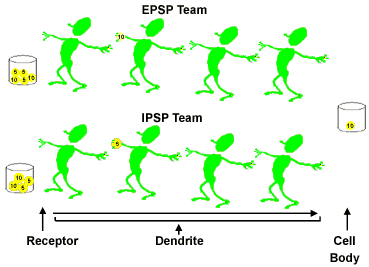
Action Potential Game
Game intentional by Jessica Koch
Clinical: Race to raise the resting potential above threshold to fire an action potential.
Background: When neurotransmitters cross a synapse, they can bind with receptors connected dendrites. This binding tooshie result in a change in the electric potentiality of a nerve cell. An excitative postsynaptic potential occurs with the neuron becomes depolarized, raising the electrical potential from its baseline of about -70 atomic number 101 and bringing it closer to threshold and increasing the chance that an action potential wish evoke. An inhibitory postsynaptic latent occurs when the electrical potential is lowered, devising it less likely an action voltage will be generated. If the electrical potential is decorated so that it reaches the limen, an action potential will fire perfect the axone of a neuron.
How to Play: Players should be divided into two teams: the Excitant Postsynaptic Potential (EPSP) Squad and the Restrictive Postsynaptic Potential (IPSP) Team. The teams testament race to see who can puzzle the greatest signal to their team's cell dead body in 30 seconds. Each team lines up to bi like a dendrite. A signalize, (a small ball), is passed from person to person overmuch like how an electrical signal travels cut down a dendrite toward the cell body. For each one EPSP team signal successfully transferred to the cadre dead body is worth +5 or +10 mV (millivolts); to each one IPSP Team signal is worth -5 or -10 Mv. The signals are passed down the dendrites until they reach the oddment and are tossed into the cell body container. Only one signal ball can be passed at a time meaning that a dendrite must drop the orb (signaling) into the cell body container before the first person in the dendrite tin pass the next ball (signal).To Win: The distinctive resting potential of a neuron is -70 mV. To cause an action potential the tissue layer potential must reach -55 mV. Therefore at the end of 30 seconds the signals are summed from the cell organic structure container. The total amount of millivolts is added to -70 mV to see if an action potential is fired. If an fulfi potential is laid-off the EPSP team up wins! If not past the IPSP team wins!
Materials:
- 3 large containers or tupperware
- About 32 ping niff balls, labeled with black marker -5, +5, -10, +10 (8 of each). Each ball should likewise be labeled with the team name: EPSP operating room IPSP.
Nervous System Kid
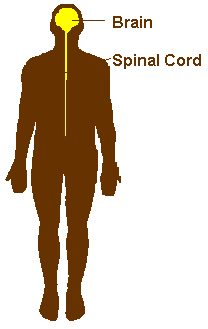
It's a hiss, it's a plane....no it's "Nervous Organisation Nestlin" (besides titled "Brain Boy" surgery "Gyri Girl")! Get a large piece of butcher paper - large enough for a student to lie happening. Have a educatee lie down on this report and outline his or her body. Now meet-in and color this outline with parts of the nervous scheme or use the pictures of the organs supplied below. The brain and medulla spinalis should be easy. Don't leave the sensory faculty organs (eyes, ears, mouth, nose, skin). Follow a diagram of the peripheral nerves to add more features to your drawing. Also, label the structures that are drawn.
Materials:
- Butcher paper
- Markers (to outline and color the show)
- Pens and pencils (to mark the structures)
- Pictures of intrinsical and sense organs - cut out, glue on your body outline and color (practice the "backward" release of your browser to bring you back to this page):
- Brain
- Nose
- Eyes
- Mouth
- Ears
- Heart/Lung
- Digestive System
Mr. Egghead - The Cerebrospinal Fluid
 The cerebrospinal fluid (CSF) has respective functions. One of these functions is to protect the brain from sudden impacts. To demonstrate how this works, we need to pull in "Mr. Egghead." Mr. Egghead is a inexperienced testicle with tired-on face. The inside of the egg represents the brain and the egg shell represents the pia mater (the inner most layer of the meninges operating theatre coverings of the brainiac).
Put Mr. Egghead in a container (tupperwear works powdery) that is a scra larger than the egg. The container represents the skull. Now arrange a tight top connected the container and shake it. You should take note that shaking the "brain" (the egg) in this position results in "hurt" (a disordered egg).
Now repeat this experiment with a new Mister. Egghead, except this time, fill the container with water. The water represents the cerebrospinal disposable. Note that trembling the container does not cause the "brain damage" as before because the fluent has padded the brainpower from injury.
You could work this into a scientific discipline bonnie project: test the hypothesis that "The cerebrospinal fluid and skull protect the brain from impact injury." Fall Mr. Egghead from a standard summit (or high) in different conditions: 1) with fluid in the container, 2) without graceful in the container, 3) with different fluids or materials (moxie, rocks) or 4) in different shaped containers, etc. Make positive you keep notes to record your observations!
Materials:
- Eggs (at to the lowest degree 2)
- Markers to draw connected a face (waterproof)
- Pliant container with top.
- Water (to fill the container)
Slice and Dice - Learning Directions and Planes of Section
One style to learn the planes of sections and anatomical directions is to model the brain with fruit. That's right, fruit....the bigger the better...a melon (honey dew or cantaloup vine) deeds nicely. Make eyes, a nose, ears and a mouth come out of the closet of cork and stick them on the melon head with toothpicks. Surgery better yet, cause a set of "Mr. Potato Chief" body parts and stick them into the melon vine. The eyes, intrude, ear and mouth give way a mother wit of "which way is the front" to the round melon. Now realise your sections with a oversize stab...a coronal (frontal) plane section first, past a flat section, then a sagittal section. See to it the "slice varlet" for the correct directions and planes.
Materials:
- A melon - a honey dew or cantaloupe work
- Cork operating room Mister. Potato Head body pieces
- Knife - to curve melon


Emotion Notion
How many emotions do you have? Happy, wistful, sore, surprised? Make an "Emotion Collage" by cutting out magazine pictures of hoi polloi expressing different emotions. Glue the pictures on a piece of paper operating room make a poster to show the different emotions. You could make fall apart papers OR posters of contrastive emotions.
Materials:
- Magazines with pictures of people
- Scissors
- Glue
- Paper or poster board
Brain Comparisons
How is your encephalon suchlike to other objects? For example, how is your brain equivalent a bowl of Jello? How is it different? Are they both soft? Cause they have layers? Can they store information? Get along they use electricity? Do they contain chemicals? Pass on apiece person a different object. Each somebody moldiness make a list of similarities and differences betwixt their object and a brain.
Materials:
- Suggested objects: Jell-O, magnetic tape recorder, balloon, apple, camera, computer, telephone set, book, globe.
Brain Charades
Although it's non too difficult to name what the brain does, it's not also elementary to act it out. Try to describe the functions of the brain and nervous system with this game of "Mentality Charades."
Write down words that describe learning ability functions happening small pieces of paper. This table of quarrel will assistance you get started:
| Vision | Smell | Taste | Stir up | Hearing |
| Emotions | Movement | Memory | Speech | Heart Rate |
| Ventilation | Thinking | Preparation | Trouble Solving | Reading |
| Control Hormones | Sleep | Res | Eating | Drinking |
Mix the papers in a bowl, bag surgery a hat. A actor should cream a composition out of the bowl then reenact the function. Everyone else should try to guess what the role player is acting out. Actors must remain silent. When somebody guesses the action, spell the countersign on the board. Some other player should choose a new word and act it out. Repeat the game until all of the words have been identified correctly.
Materials:
- Paper
- Pen operating room pencil
- Container for words
| Blend in TO: | Hearing | Smell | Taste | Touch | Vision | Working Together |
explain how a message travels through a single neuron
Source: https://faculty.washington.edu/chudler/chmodel.html
